Graycare (graycare.net) is a participant in the Amazon Services LLC Associates Program, an affiliate advertising program designed to provide a means for us to earn fees by linking to Amazon.com and affiliated sites. Learn More

I’m writing to unpaid family caregivers in Michigan, to help you learn if you can get paid for the care you provide.
We’re talking about the Home Help Program from the Michigan Department of Health and Human Services (MDHHS), which gives free in-home care to applicants who qualify for Medicaid.
Graycare (graycare.net) is NOT a Lawyer or Doctor, and certainly ain’t no ombudsman.
As far as I know, these are the #1 and #2 most important web pages for Michiganders, who are currently unpaid caregivers, who want to find accurate information about how to get paid by the Michigan State Government for the caregiving they do:
#1 Click here to visit the Michigan.gov page: Home Health Program for Individual Providers.
#2 Click here to read the full PDF May 1, 2023 version of the MDHHS HOME HELP CAREGIVERS PDF (ASM 135).
The HOME HELP CAREGIVERS PDF is the ADULT SERVICES MANUAL that gets down-to-details on what you need to be, and what you need to do, to qualify for paid caregiving to a person you’re already caregiving for in Michigan.
I’m lil gangreen, an eager caregiver helper who has summarized the PDF for you.
QUESTION: I'm a family caregiver in Michigan. Will the State of Michigan pay me for the care I provide to another Michigander?
TRUTH: There are several, several requirements you must satisfy first.
First, know your role:
My friend, you need to look it up on the ASM 138.
Click here to view the ASM 138 PDF on the Michigan.gov website.
The most up to date version was published in February of 2023, so look for the "2-1-2023" date on the PDF. And if you find a new version, feel free to contact me in a jiffy!
Click here to visit the Home Help Program main website.
To get state-funded in-home care from the Michigan Home Help Program, the applicant has to be poor and disabled.
Michigan’s middle-class is too rich to qualify for Medicaid, and therefore doesn’t qualify for the Home Help Program. What’s more, poor people who do qualify can’t choose their spouse or parent to be their state-funded caregiver.
The applicant must qualify for Medicaid. Most seniors domicile with their spouse or alone, and most seniors report taxes to the government individually or jointly. It matters because:
Less than low income, the applicant must next-to-zero assets, like cash savings or a property ownership. [American Council on Aging]
Your home (primary residence) and car (motor vehicle) are two types of assets exempt from Medicaid eligibility. You can qualify for Medicaid while owning one home and one automobile (as long as the home is valued under $595,000, plus the applicant lives in the home and uses the automobile).
The so-called “Functional Requirements” are the easy part. A Medicaid employee will assess the applicant to determine whether or not they need assistance with at least one of seven “Activities of Daily Living (ADLs)”. Those include eating, bathing, using the toilet, dressing, cooking, housekeeping, taking medication, personal hygiene, doing laundry, and essential shopping.
Michigan Home Help Program pays Agency Providers 62% more money than Individual Caregivers.
What's happening is family, neighbors, friends, and the MDHHS agree caring for someone you care about is worth 38% less than caring for a stranger.
If the caregiver is the spouse or responsible guardian to the applicant, the caregiver can’t get paid by the state. What's happening is, when you keep your promise "to care for the other in sickness and in health", now you don't get money for your care.
As a child, friend, or neighbor to the applicant who chooses to give long-term care, it’s possible to get money by logging hours in the CHAMP System.
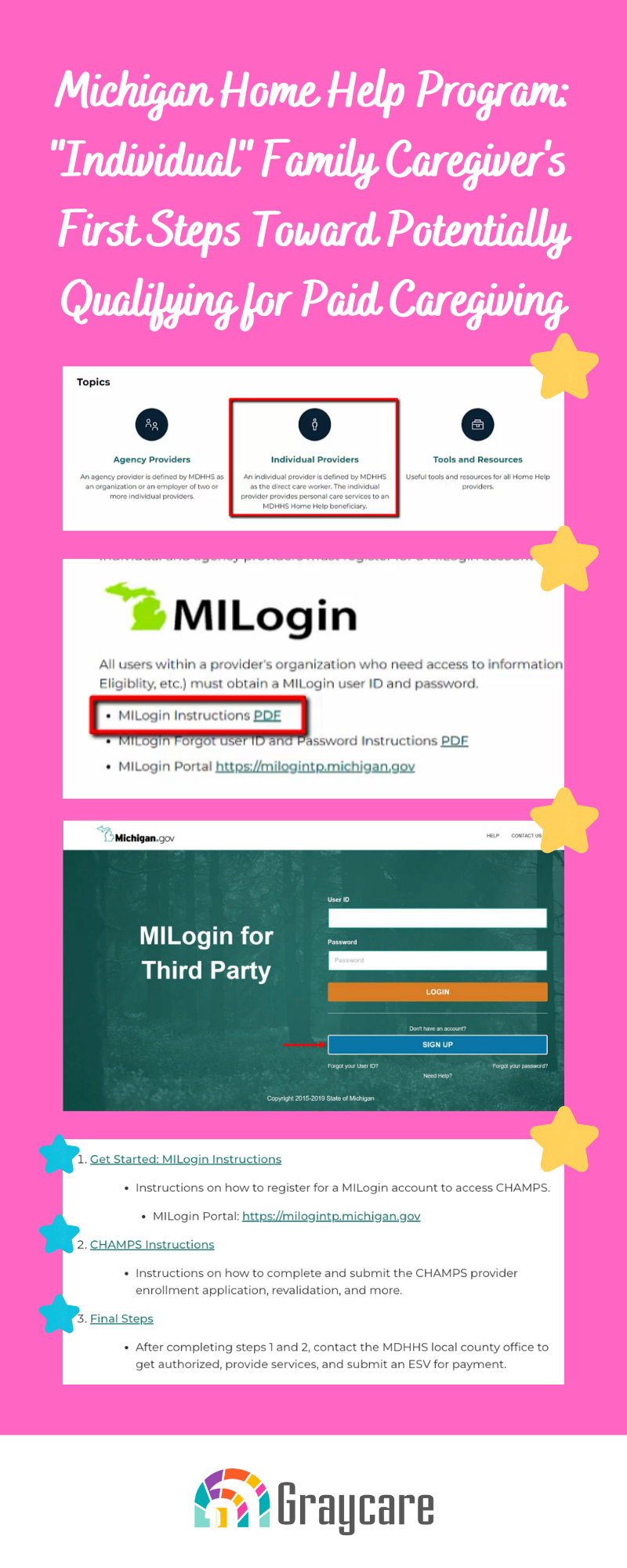
Once an “applicant” gets approved, they become a “client”, and can hire or fire a state-funded “home help caregiver”.
An “individual caregiver” is like an independent contractor. They work for themselves without representing a company or agency, as opposed to an “agency provider”.
If you are a relative or friend who gets paid to provide care for someone you know, then you are an “individual caregiver”.
If you are a person who gets paid to give care for clients as a self-employed venture, then you are an “individual caregiver”.
To be a Michigan state-paid caregiver for a client under the Home Health Program…
Another roundabout way you can get a financial benefit by serving as a family caregiver are tax deductions and credits.