Graycare (graycare.net) is a participant in the Amazon Services LLC Associates Program, an affiliate advertising program designed to provide a means for us to earn fees by linking to Amazon.com and affiliated sites. Learn More

Dear Barbadensis Miller,
I’m an adult male who drank one gallon jug of refrigerated aloe very juice over sixteen days, shaking before serving each time.
Sipping liquid aloe, I’ve learned aloe vera is the same thing as aloe barbadensis miller, so I am writing to you.
The jug I’m sipping from suggests 2 to 8 ounces daily, so to test it out, I sipped my first chilled glass of aloe vera juice at just 2 ounces. Nothing bad happened to me, so after 3 hours I shook it well and drank another 6 ounces.
Since I tried my new aloe drank at a safe lowdose, now I’m on the full 8 ounces for the recommended 16 days daily. That’s because 1 gallon is equivalent to 128 ounces and you can drink an 8 ounce glass for 16 days before I’ll see you at Trader Joe’s again. 👋🏽
When testing new juices with possible health benefits — like aloe vera — try the minimum recommended dose to extra stay safe.
Graycare is NOT a doctor.
🩻 Warning: Don’t exceed the recommended dose of aloe vera juice. Read the instructions on the back of the aloe vera juice bottle. Rumors like eating watermelon seeds will grow watermelons in your stomach are in-line with rumors you’ll turn rigid like a hard rine vera leaf from drinking too much aloe vera. Consult a doctor before experimenting with aloe vera in your glass. Do NOT feed aloe vera juice to your kids. When I drink the aloe, it’s important that I’m an adult who’s not pregnant, nursing or taking meds — because you should NOT drink aloe vera juice if you are adolescent, if you are pregnant or nursing, if you are taking other medication, or if you feel bad after your first drank.
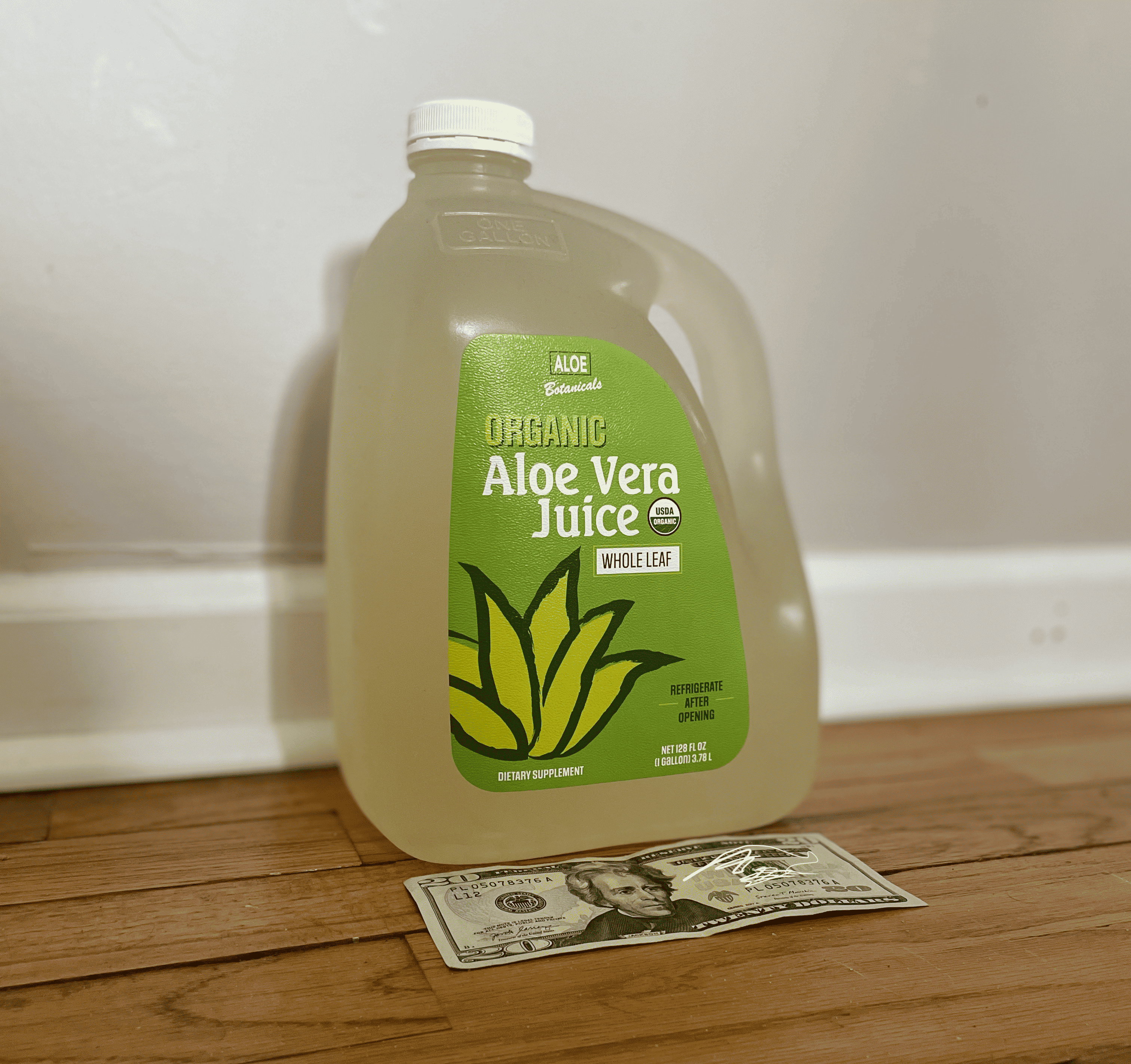

My first impression? It tastes like cactus!
Chilled, it looks and tastes mostly like water, but has a lemon taste paired with a refreshing, succulent “aloe” taste in the same ballpark as unsweetened coconut water — this time cracked from an aloe vera leaf.
Store-bought aloe vera juice has a subtle citrus flavor and a hint of sweetness, good and succulent from a blue-tinted green leaf in the desert.
The aloe vera plant is about the same size as a shrub, but an aloe vera plant is surely no bush. Its spear-shaped leaves can grow 12 to 24 or — even 36 inches tall if you're growing aloe Texas style. Its stemless leaf clusters are shaped like a rosette (the shape of an Outback Steakhouse original deep-fried onion).
The aloe vera plant is succulent (its leaves are fleshy to retain water), it's perennial (it blooms year after year), it's xerophytic (it grows well without much water), and I like the way this blue-tinted green color plant looks and feels when found in nature and neighborhoods.
The aloe vera plant itself has a history of over 2,000 being used by humans for health, beauty, and and medicinal purposes. (Source: NIH, Indian Journal of Dermatology). Aloe vera is is a plant known for its anti-inflammatory, antimicrobial, and wound healing properties.
A 2024 study with cancer patients who received radiation chemotherapy found aloe vera juice used as mouthwash might be good for mouth and throat inflammation and ulceration. (Source: NIH, MDPI Molecules and NIH, Journal of Research in Medical Science)
“2,000 soothing years of counting” Who knows what they’ll say about aloe vera next?!
Typical aloe vera juice contains the ingredients: water, aloe juice and/or aloe juice concentrate. Some brands will add a splash of lemon juice (concentrate) for taste and pH balance.
Aloe vera juice is made by mixing and filtering parts of the aloe vera plant.
.
Aloe products with anti-inflammatory properties are made from gel, and aloe products with laxative properties are made from latex.A cross-section of the aloe vera leaf exposes its three unique layers, the aloe rind, latex, and gel:

After purchasing Trader Joe’s Aloe Vera Juice, I wrote a letter in care of Barbadensis Miller and addressed it to Aloe Botanicals in Denton, TX. That’s because this one gallon aloe vera juice jug I’m suckling was made in the United States.

The jug says this aloe vera juice is healthy for ingestion and good for both immune support and joint health. I listened to Trader Joe’s instructions on how much aloe vera juice to drink, and kept it at 8 ounces per day, down the hatch!
The jug says these statements have not been evaluated by the FDA, so the product is not intended to diagnose, treat, cure or prevent any disease. That’s too bad for ill aloe drinkers, but thanks for letting us know.
I will recycle this jug, thank you.
Have a great day,
Graycare LLC
contact@graycare.net