Graycare (graycare.net) is a participant in the Amazon Services LLC Associates Program, an affiliate advertising program designed to provide a means for us to earn fees by linking to Amazon.com and affiliated sites. Learn More
#Professional Caregivers
#CaregiverJobTitles
#WorkingCaregivers
Saying the right job title when speaking with a professional caregiver isn't always so straightforward.
Trying to figure out caregiver job titles is like reading a bowl of alphabet soup while you’re three hours deep into a double shift. Whether you’re a care pro looking for your next client or a family member trying to figure out who just walked through your front door, the jargon is exhausting. We we made a fast-track for clarity on caregiver job titles:
People searching for what to call a caregiver, caregiver job titles, or CNA vs HHA vs PCA are usually trying to avoid a simple mistake: using the wrong title when hiring, interviewing, or describing care work. In the U.S., caregiver titles aren’t just semantics — they signal training level, legal scope of work, and who is allowed to perform medical tasks. Understanding these caregiver roles upfront saves time, prevents liability issues, and avoids awkward conversations later.
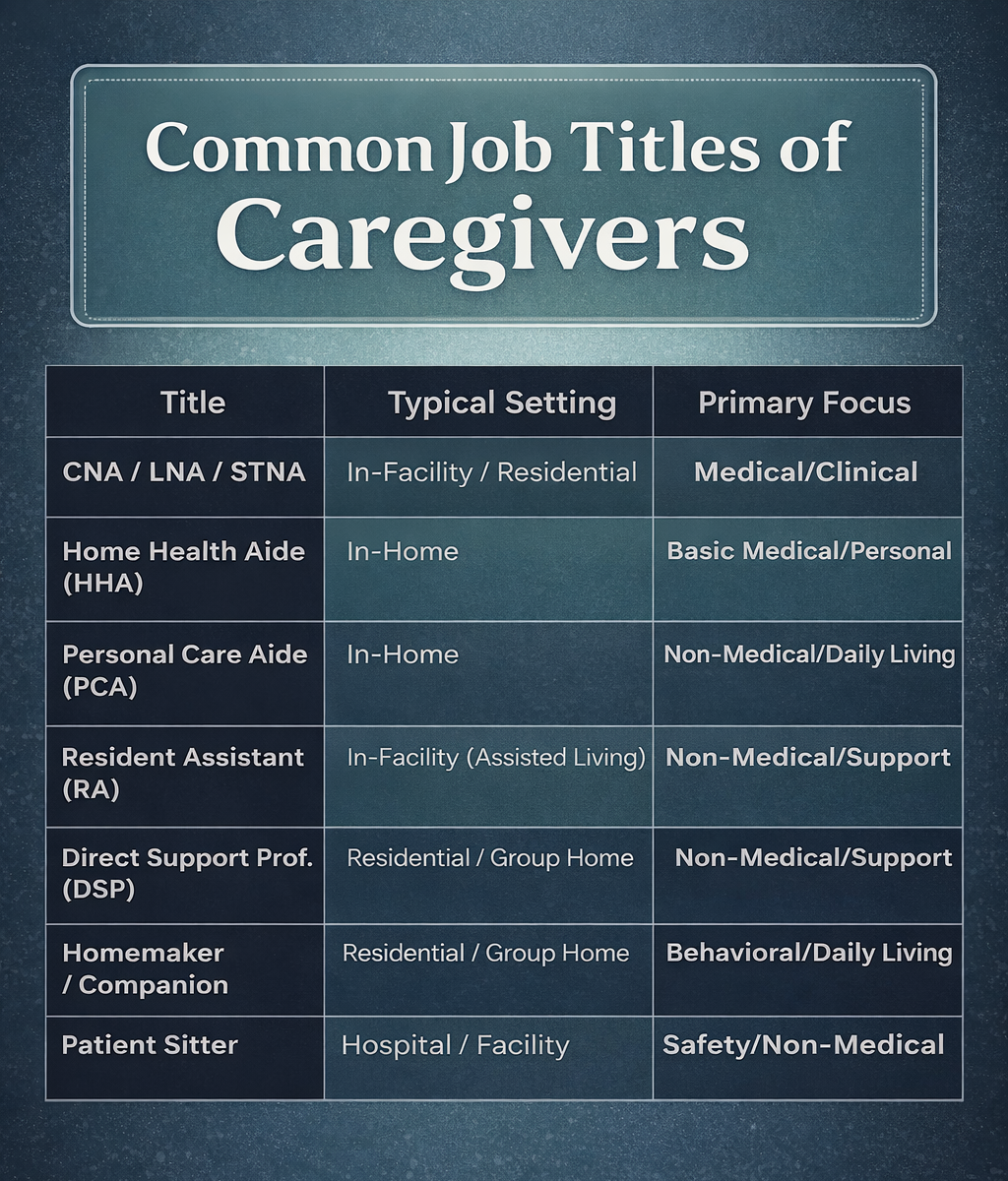
1. What are the need-to-know job titles when speaking to professional caregivers? The "Big Three" you’ll hear most are CNA (Certified Nursing Assistant), HHA (Home Health Aide), and PCA (Personal Care Aide).
2. Do different job titles indicate different levels of certification? Yes! While some titles are just fancy marketing to get you to click an ad, they generally follow a hierarchy of medical training—moving from non-medical companionship up to state-certified medical support.
3. What are the different terms for a "caregiver" at the CNA level or below? In the care industry, we call these "direct care workers." This bucket includes everyone from Resident Assistants in facilities to Direct Support Professionals and Homemakers in the community. There is a type of care for every need, we'd hope.
Don't let the job boards fool you — some employers use titles made of "marketing fluff" designed to make one company sound more prestigious than the next. When trying to understand the scope of the job, here's how to understand what indicates a true legal requirement and what's just a "fluffy" recruitment phrase.
In the U.S. care industry, a professional caregiver is any paid worker providing assistance with daily living, supervision, or health-related tasks — but only state-regulated roles (like CNAs and certain HHAs) are legally permitted to perform medical or clinical duties. All other caregiver titles generally fall under non-medical support unless otherwise licensed by the state.
Even if a role doesn't require a state license (like a Companion or Homemaker), you'll still have to apply for the job and do some paperwork. Professionalism is expected from care professionals. Expect a rigorous background check and a drug test — which, depending on the employer could request a sample of your urine or hair. If you’re serious about the "Caregiver Lifestyle," keep good records, and stay clean.
For professional caregivers, your workplace and employer ultimately decide your job title and what you’re allowed to do in the role.
There are either jobs performed in the homes of your clients, or there are jobs performed in a healthcare facilities where short-term or long-term clients visit on location during the day and/or stay overnight.
Here at Graycare LLC we try to document these caregiver job title distinctions because confusion around titles is one of the most common pain points we see among families, working caregivers, and first-time hires. When terminology is unclear, expectations break down — especially between in-home care, facility care, and agency-based roles. Key differences between the home and the facility include:
By writing a job description allocating percentages to the time spent on different duties of a caregivers, let's understand the care professional's daily grind. These percentages are estimates, but they represent a typical shift.
Typically works in-facility as the clinical backbone of the team.
Works in-home as the "Swiss Army Knife" of home care.
Works either in-home or in-facility as the master of routine and relationship.
Q: Why do I see so many different acronyms for the same job?
A: Regional flair! A CNA is the national standard, but if you’re in Ohio, you’re an STNA (State Tested). In New Hampshire, you’re an LNA (Licensed). In Maryland, you might be a GNA (Geriatric). They are essentially the same clinical tier, just with a local accent. If you're a CNA in one state looking to get a CNA job in another state, *MOST* states will let you transfer your CNA certification from one state to another.
Q: Which caregiver role requires the absolute highest training level in this group?
A: The CNA (or LNA/STNA). You have to complete a state-approved program and pass a clinical skills and written exam to get those initials behind your name.
Q: Which caregier jobs require a state-mandated certificate to work?
A: CNAs and HHAs (specifically those listed as CHHAs). If you’re working for a Medicare-certified agency, that HHA certificate is a legal must-have.
Q: I don't want to do medical stuff. Which caregiver jobs should I search for?
A: Stick to PCA, Companion, or Homemaker. These are typically non-medical and focus on the "Caregiver Lifestyle" of support rather than clinical intervention.
Navigating these titles is just the first step in mastering the caregiving journey. Whether you’re a "Life Skills Trainer" in a group home or a "Senior Care Specialist" helping a neighbor, the heart of the work is the same: you are the guardian of someone’s quality of life.
At Graycare, we know that the "Psychology of Caregiving" is heavy. It’s why we advocate so hard for "Self Care for Family Caregivers." You can't pour from an empty cup, and you certainly can't navigate a double shift if you're running on fumes. Stay strong out there, keep your head clear, and don’t forget to fill your own cup while you’re busy filling everyone else's.