Graycare (graycare.net) is a participant in the Amazon Services LLC Associates Program, an affiliate advertising program designed to provide a means for us to earn fees by linking to Amazon.com and affiliated sites. Learn More

No doubt. People living with dementia have a special set of challenges. Their caregivers to too.
Both roles manage dementia’s specific neurocognitive changes in thinking, memory, and independence.
But what are those unique challenges? And how do dementia specialists approach them for real?
I’m saying… Safety first, enrichment second. It seems like *most* types of elder care make the same claims: meals and housework, prevent falls, regulate medication, and the like. These things apply to any aging person.
If caregiving services for dementia patients cost so much more, then which unique service merits the extra cost?
“It’s not as easy to take care of dementia patients, so that’s why we charge more,” said the imaginary nursing home manager who couldn’t come up with a better reason. This imaginary manager proceeds to charge you almost twice as much money for caregiving services because your loved one has dementia.
A dated yet relevant elder care industry intelligence report by Open Minds think tanks Griffin, Oss, and Threnhauser highlights: $157 billion to $215 billion in the United States was spent between 3.7 million Americans affected by Alzheimer’s disease or other dementias. #ad That's about $55,000 per per per person with dementia. ($200,000,000,000 dollars / 3,700,000 people = $54,054 dollars per person)
When you look at dementia care cost versus non-dementia care cost, it’s true: dementia care costs more.
The National Institute of Health (NIH) published 2015 research showing “health care costs for dementia found greater than for any other disease (more below)”
For families, out-of-pocket spending for those with dementia was $61,522 compared to $34,068 for those without dementia. Informal care costs were estimated to be $83,022 for people with dementia vs. $38,272 for those without dementia. In addition, out-of-pocket spending as a proportion of total household wealth five years before death was significantly higher — median of 32 percent for dementia and 11 percent for other diseases. For African-American households the median out-of-pocket expenditure was 84 percent of household wealth for those with probable dementia.
The care provider’s job is to assist the dementia patient to facilitate health, wellness, and an overall safe and enriching environment.
Since dementia is a neurodegenerative disease, caregivers of dementia must address declining ability to solve problems, remember things, and socialize with others.
If dementia care takes place outside the home at a healthcare facility, then maybe healthcare facilities for dementia hire more staff per patient on average.
More staff means better care? Recent research shows that’s not necessarily true.
2019 research from the NIH states the obvious: “More staff = better quality of life for people with dementia [...the study showed…] that there was no significant effect of the total staff-resident ratio in explaining the variation in [dementia care facility residents’ Quality of Life]”.
OK, so if more staff doesn’t equate to better dementia care, then is it the number of hours? A neuro-normal elderly person (where physically able) might spend an entire night by themselves. But for a demented elderly person (where physically able) possible run-aways with slip-and-falls or nighttime-snacks with scissors-and-knives are significant causes for extended hours of care.
Yes, people living with dementia will likely require long hours of care once dementia symptoms merit. The Alzheimer’s Association states: “During the middle stages of Alzheimer's, it becomes necessary to provide 24-hour supervision to keep the person with dementia safe.”
That’s one reason why dementia care costs more, because dementia care requires longer hours of care than non-dementia care (given equal physical ability). So it adds up.
But I’m still not satisfied. That’s because dementia care costs more per hour than non-dementia care. So there must be something different about dementia care!? Why else would I pay more for it per hour?
Dementia care costs ≈23% more per hour, since hourly wage is a strong indicator of cost of the service.
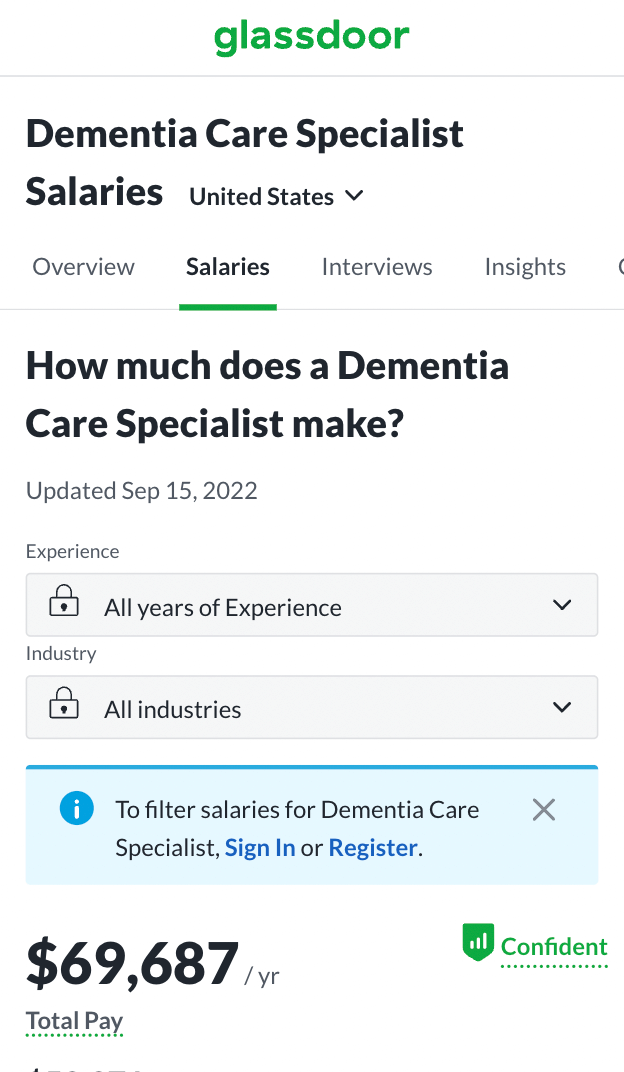
According to Glassdoor 2023 aggregate salary data, dementia care specialists earn $69,687 annual salary, while a senior care specialists earn $56,429. Dude, it’s an apples-to-apples comparison now (dementia care cost vs non-dementia care cost).
Again, dementia care costs more.