Graycare (graycare.net) is a participant in the Amazon Services LLC Associates Program, an affiliate advertising program designed to provide a means for us to earn fees by linking to Amazon.com and affiliated sites. Learn More
Elder Care in Michigan is worth your consideration. Give it a think if you’re lucky enough to have parents alive. I’m lucky like that to date.
How can Michigan become a leader in elder care?
I Honor Paula Duren.
The phenomenon known as “The American Sandwich” means, in the coming decades, the number of American adults supporting both children and the elderly will rise year by year. For the adult, it’s like getting sandwiched between two costly burdens. Yep, for adults in Michigan too.
Not all neighborhoods provide sufficient support for elderly care.
Not all “Economic Class Divisions” either.
Today in Michigan, it’s most common to get State-funded elder care for people who are Under The Wage Level. Those blessed enough to be comparatively wealthy family circumstances are basically left to shoulder elder care costs on their own dime.
The COVID-19 pandemic has raised awareness about how Michigan communities can bridge gaps in care and improve quality of life for older residents. [Model D]
The well-off in The Mitten can afford excellent care. According to local media outlet Model D, that’s a problem in Michigan. The divides, bridges, and gaps between good elder care in Michigan.
The State of Michigan does have what is call the “State Innovation Model”.
State Innovation Model
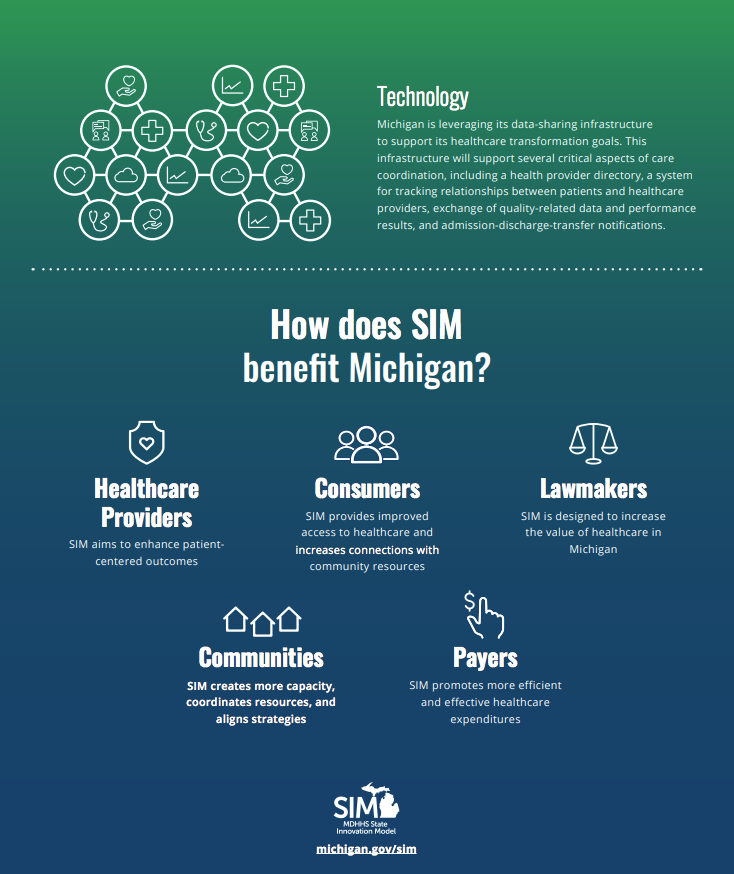
“The Role Of Health Technology in Michigan” is without a doubt an integral part for Michigan’s efforts to achieve balance, considering the the current high pressure circumstances for the middles class, especially those “Michiganders in a Sandwich”.
Here’s an example of what innovation looks like today in Michigan. The “PACE Program” has been described as the “lesser-known elder care option”. This indicates an awareness problem. Most Michiganders who could benefit from PACE don’t know about PACE.
One reason? PACE Program has a helpful website, but they have separate websites for different regions. So it’s hard to know what’s what these days. For example, you don’t know for sure which elder care options are available to you.
Just saying. This little confusing thing isn’t so bad. By comparison, the State of Michigan’s MDHHS website for the “Home Help Program” is much harder to navigate and find information.
(P.S. The traditional Medical Home Help Aid program is mostly only accessible by People in Michigan on Medicaid. Glad you guys got the support!)
Maybe part of the PACE Program’s problem is they haven’t communicated well enough that, actually People with Medicare Coverage can qualify for the PACE Program. I’ve heard it’s expensive, like $4,000.00 to $6,000.00 for a 70+ year dude with Parkinson’s disease and dementia.
It’s such a tough spot to be in for hundreds or thousands of Michigan families. For families who are above the Medicaid line but not wealthy enough to afford quality elder care, the challenge is real.
According to the report “Findings and Lessons from our Investments since 2015?”, Michigan’s imbalanced elder care economy will only grow worse every decade. So, Michigan’s fresh chicken Gen X should take heed!
Technology will undoubtedly be an integral part of Michigan’s journey to become Innovative on Elder Care.
I really hope, hope, hope to see a leader One of Michigan’s Tech Leaders step up and make a project out of it. Call it, “I’m a Tech Guy Who Can Solve Michigan’s Elder Care.” Big ups to you if you can solve that problem, dude/madam!
Hey, Show Me!
(We’re talking about Michigan, Not Missouri. Though that is where my father is from. The Show Me State. You know, the father with several concurrent progressively debilitating diseases who I live with and financially support and take care for?)
There’s a common saying in tech to describe how tech guys/ladies work: “Fall In Love With The Problem”. The high-pressure circumstances my family is facing with my dad are a good example of The Problem.
U of M describes the whole thing better than me.
As we turn the page to 2023, I look forward to more stories of elder care innovation in Michigan!