Graycare (graycare.net) is a participant in the Amazon Services LLC Associates Program, an affiliate advertising program designed to provide a means for us to earn fees by linking to Amazon.com and affiliated sites. Learn More

Job descriptions that assigns weighted percentages to responsibilities help employees understand how to prioritize their time, especially in remote work environments where expectations are less visible. It's 70%, 20%, 10% easier for new hires to start day one aligned for a good workday.
As a non-HR professional, it’s not my place to reinvent the job board or the job application process. But as a job seeker who has applied to hundreds of roles, it is my place to have a preference.
Without a doubt, I prefer job descriptions that divide job responsibilities by percentages.
When a job description approximates how much of your time you’ll spend on each aspect of the role — 25% here, 15% there, 5% elsewhere — the employer demonstrates respect for the employee’s valuable time. It shows they’ve thought about what the job actually looks like week to week, not just what sounds good in a bulleted list.
For job seekers evaluating remote jobs, work-from-home roles, and laptop-based careers, job descriptions matter more than ever. Clear job responsibilities, realistic time allocation, and transparent expectations can determine whether a remote role feels sustainable or overwhelming. When employers explain how a full-time workweek is actually spent, candidates can better assess fit, focus, and long-term success in remote work.
This kind of clarity matters even more in remote jobs.
When you work remotely, there are fewer visual cues to guide your priorities. You don’t see who’s stressed. You don’t overhear what’s urgent. You don’t catch context by walking past a desk or sitting in on a meeting by accident. Much of the work happens asynchronously, often without immediate feedback.
In that environment, vague expectations create unnecessary anxiety. If everything looks equally important on paper, it’s easy to assume everything is urgent all the time.
Percentages replace missing context. They act as a stand-in for the guidance you would normally absorb in a physical workplace. They give you a mental model for how to spend your day without needing constant clarification or permission.
A job description that details responsibilities by percentage is fundamentally different from one that simply lists task after task.
Reading responsibilities down the line leaves it up to the employee to divide their time. It expects the employee to prioritize tasks based on their own skills, preferences, and judgment. When you don’t tell the employee how many hours of a full-time workweek should be allocated to a given task, you leave how they spend their time open-ended.
By contrast, percentages act as a general guideline for how to succeed in the role. They show how the employer expects work to be distributed in order to meet business goals.
This makes it easier, once on the job, for an employee to report how they spent their time using the same language — percentages — and map their activities directly to their responsibilities.
On the job, one manager sets a deadline. Another manager sets a different deadline. Handling deadlines becomes the most pressing way an employee prioritizes work.
As priorities shift and projects overlap, work often becomes a cycle of constant re-prioritization. Multiple projects mash together, and it can feel like tossing in one more object to juggle when you already have several in the air.
This is especially true in office jobs and remote jobs, where time boundaries are looser and expectations are easier to misalign.
When percentages are used to guide how an employee allocates their effort each day or week, it helps keep work aligned with expectations — even when deadlines compete.
Starting a new job is already high-pressure.
You’re learning systems, names, tools, unspoken rules. You want to fit in. You want to be useful. You want to prove you were the right hire — quickly.
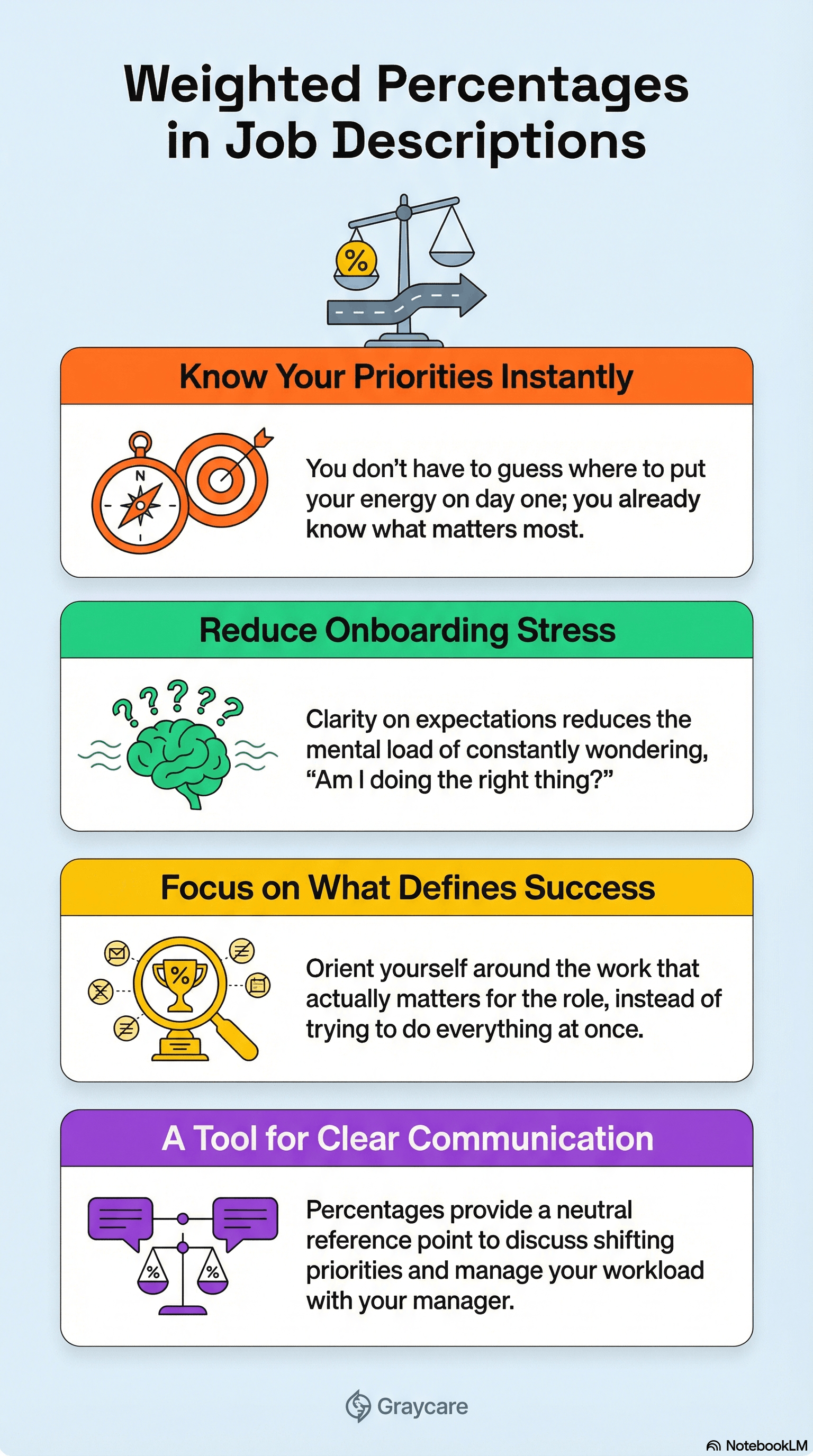
When a job description includes percentages, you don’t have to guess where to put your energy on day one. You already know what matters most. You know which tasks deserve focus and which ones are supporting players.
Instead of trying to impress everyone at once, you can orient yourself around the work that actually defines success in the role. That reduces the mental load of constantly asking yourself, “Am I doing the right thing?”
Clarity doesn’t remove the challenge of learning a new job, but it removes unnecessary friction while you’re learning.
Percentages don’t just help employers set expectations. They also give employees language.
When priorities start to drift, percentages provide a neutral reference point. If a new task starts consuming more time than expected, you can point back to the original allocation and ask how it should be adjusted.
They make it easier to explain tradeoffs without sounding defensive. Instead of saying, “I didn’t get to that,” you can say, “That work pulled time away from the area that was expected to take the largest share of my week.”
Used this way, percentages help employees manage scope creep and protect focus. They turn time management into a shared responsibility instead of a silent struggle.
It’s extra meaningful when a job description lists percentages because it shows a potential employee exactly how they’ll be spending their time once they start.
In those cases, it’s no longer up to the supervisor and new hire to invent a plan of action from scratch just to define day-to-day work. Expectations are already aligned before the first day.
An alternative that can also work is outlining what the role focuses on daily, weekly, and monthly. Clear cadence beats vague phrases like “as needed” or “occasionally,” especially in remote roles.
A job description that clearly sets expectations about daily work — whether by percentages or another weighted structure — tends to attract employees who work well with OKRs. These employees can plan their schedules, block their time, and justify how their work aligns with business goals.
When both the employer and employee already agree on how time should be spent, performance conversations become less subjective. It stops being a guessing game.
For job seekers, especially those looking to work remotely from an internet-connected laptop, job descriptions with percentages aren’t just easier to read. They’re a signal of how thoughtfully the company approaches work, time, and expectations.
[...In organizational psychology and workforce research, role clarity is consistently associated with higher job satisfaction and stronger performance outcomes. Clear expectations reduce cognitive load, speed up onboarding, and improve decision-making — especially in distributed and remote teams...]
Are weighted time job descriptions a form of micromanagement?
No. They set priorities, not procedures — you still choose how to approach the work, but you’re not left guessing which objectives matter most or how your time is expected to balance across them.
Do weighted percentages lock me into a rigid schedule?
No. They describe emphasis, not minute-by-minute control. They’re a guide for how work should generally balance out over time.
What if the job doesn’t match the percentages once I start?
That mismatch is exactly what percentages make visible. Without them, you might feel the imbalance but struggle to articulate it.
Should I ask about this in an interview?
Yes — especially for remote roles. Asking how time is expected to be allocated shows you’re thinking about outcomes, not just tasks.
Do percentages change as the role evolves?
They can, and that’s normal. What matters is that changes are discussed, not silently absorbed by the employee.
Why should employers bother doing this extra work?
Because clear time allocation reduces misalignment, burnout, and early attrition. When employees know how success is measured, they ramp faster, ask better questions, and make fewer incorrect assumptions about priorities.